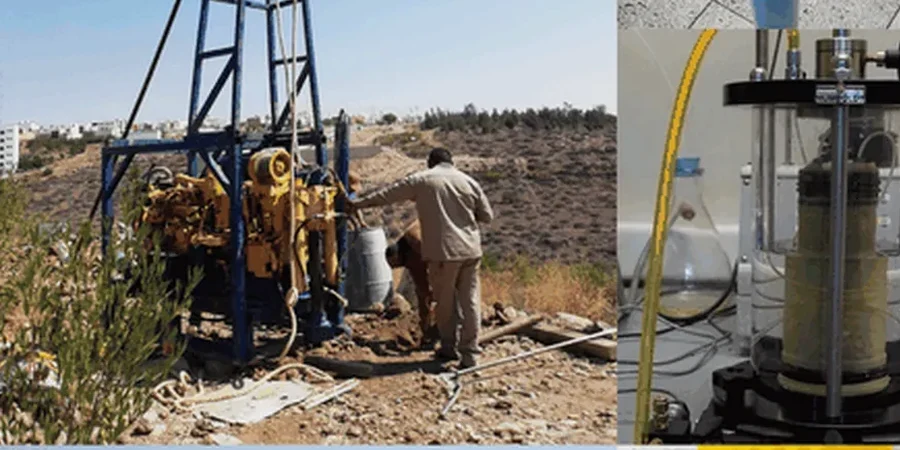
Glasgow’s transformation from a heavy industrial port on the River Clyde into a modern commercial hub left behind a complex legacy underground. Victorian basements, infilled quarries in the Gorbals, and deep deposits of glacial till overlying Carboniferous bedrock create a layered puzzle for any engineer breaking ground here. A thorough soil mechanics study untangles that puzzle. We run laboratory and field programmes that quantify strength, compressibility, and drainage parameters—precisely what a structural designer needs before placing loads on Glasgow’s notoriously variable superficial deposits. When borehole logs show soft cohesive layers, our team often follows up with a triaxial test to define the effective stress failure envelope under drained conditions, ensuring the foundation model reflects actual site behaviour rather than conservative textbook assumptions.
In Glasgow, the difference between a 200 mm and a 600 mm foundation slab often comes down to the consolidation parameters measured in a single oedometer test.
Site-specific factors
Glasgow’s rainfall—averaging over 1100 mm annually with no reliable dry season—keeps the upper strata of the till persistently near saturation, which directly reduces effective stress and effective shear strength. This climate reality combines with the city’s industrial infill legacy: old brickworks, coal pits, and undocumented backfill that can harbour perched water tables or aggressive groundwater chemistry. A soil mechanics study that skips chemical testing risks missing sulphate attack potential on buried concrete. We have seen Class DS-2 and DS-3 ground conditions on brownfield sites in the East End that required sulphate-resisting cement specified per BRE Special Digest 1. Overlooking these interactions between water, chemistry, and strength parameters leads to foundation degradation long before the design life expires.
Questions and answers
What is the typical cost of a soil mechanics study in Glasgow?
The cost ranges between £2,700 and £4,190, depending on the number of specimens tested, the complexity of the testing suite (classification only versus full triaxial and consolidation), and the borehole programme required to obtain undisturbed samples. A site-specific quotation is always prepared after reviewing the desk study and proposed ground investigation scope.
How long does laboratory testing take once samples arrive?
Basic classification and compaction tests report within 5 to 7 working days. Consolidation and triaxial shear tests require longer—typically 10 to 15 working days—because the specimen must be fully saturated and consolidated to the in-situ effective stress before shearing. We run multiple oedometer frames and triaxial cells in parallel to keep programme durations practical.
Which shear strength parameters should I use for Glasgow glacial till?
For short-term (undrained) analysis, use cu from triaxial compression. For long-term (drained) analysis, effective stress parameters c' and φ' are appropriate. Glasgow till typically shows c' between 0 and 5 kPa and φ' between 29° and 35°, but site-specific testing is essential because the till matrix varies with sand lenses and cobble content. We sample and test at multiple depths to capture that variability.