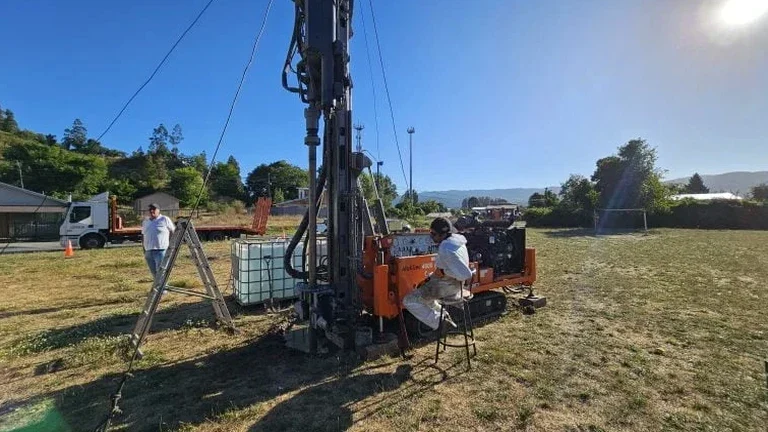
The 5-tonne tracked excavator positions itself over the trial area on a damp Glasgow morning, its bucket cutting through weathered pavement and into the underlying boulder clay. Within an hour, the exploratory test pit reveals what boreholes often miss: a sharp contact between the stiff glacial till and the saturated silty sand lens that runs beneath this section of the Clyde Valley. Our laboratory team logs every exposure directly at the pit face, measuring bedding dips, recording moisture ingress, and collecting bulk disturbed samples before the walls can slump. For sites across Glasgow where coal mine workings, buried river channels, or anthropogenic fill complicate the ground profile, the exploratory test pit provides a visual record that no indirect method can replicate. We typically reach depths of 3.0 to 4.5 metres using a step-battered profile, though deeper inspection requires shoring and a specific slope stability assessment for the temporary excavation if nearby structures exist.
A single exploratory test pit in Glasgow's till can expose more geological information in two hours than a week of desk study.
Process and scope
BS 5930:2015+A1:2020 governs every exploratory test pit we open in Glasgow, from the initial service clearance scan through to the final reinstatement of the surface. The city's drift geology makes this particularly relevant: the Quaternary sequence here alternates between stiff lodgement till, laminated clays, and pockets of running sand that can collapse within minutes of exposure. Our technicians carry out in-situ density measurements using the sand cone density method on compacted fill layers encountered mid-profile, providing a direct correlation with the laboratory compaction curves generated later. Each pit log records the full stratigraphic column with Munsell colour notation, consistency indices for cohesive layers, and relative density descriptors for granular horizons. Photographic records are taken at every metre of depth, and we recover representative samples for moisture content determination, particle size distribution, and Atterberg limits testing back at our accredited facility.
Site-specific factors
Glasgow's population of over 630,000 sits atop one of the most extensively mined urban landscapes in Britain, with shallow coal and ironstone workings dating back to the 18th century. An exploratory test pit opened without a prior coal mining risk assessment can encounter unrecorded bell pits or crown holes that have migrated upward through the drift. The 2007 incident on a construction site near Shettleston, where a 4-metre subsidence feature opened during excavation, underscores the hazard. Our risk protocol requires a full statutory review of the Coal Authority's interactive map data and, where indicated, we adjust pit locations to avoid suspected void zones. In the boulder clay that mantles much of the city's northern districts, we also watch for perched water tables that can destabilise pit walls within minutes of exposure—a condition that demands constant vigilance and immediate shoring decisions on site.
Questions and answers
What is the typical cost of an exploratory test pit in Glasgow?
The cost for a single exploratory test pit in Glasgow typically falls between £350 and £700, depending on access conditions, depth required, and whether the material is easy digging or requires breaking through hard-standing or obstructions. This range assumes a standard tracked excavator and a single day's mobilisation within the city limits.
How close can a test pit be opened to an existing building in Glasgow?
We generally maintain a 1:1 horizontal-to-depth ratio from the nearest foundation, meaning a 2-metre-deep pit should be at least 2 metres from the building line. In Glasgow's tenement districts with shallow strip footings on boulder clay, we often increase this offset and may recommend a temporary support system to prevent undermining during excavation.
What happens if you encounter mine workings during the excavation?
If the bucket breaks through into a void or heavily fractured ground indicative of shallow mine workings, excavation stops immediately. Our protocol involves securing the area, notifying the Health and Safety Executive if required, and liaising with a mining engineer to assess the extent of the workings before any further intrusive work proceeds.
How do you reinstate the ground after completing the exploratory test pit?
We backfill in compacted layers using the excavated arisings where suitable, or with imported granular fill if the original material is contaminated or unsuitable. Each 300 mm lift is mechanically compacted, and the surface is restored to match the existing grade, with paving or asphalt reinstated as close to the original condition as possible.