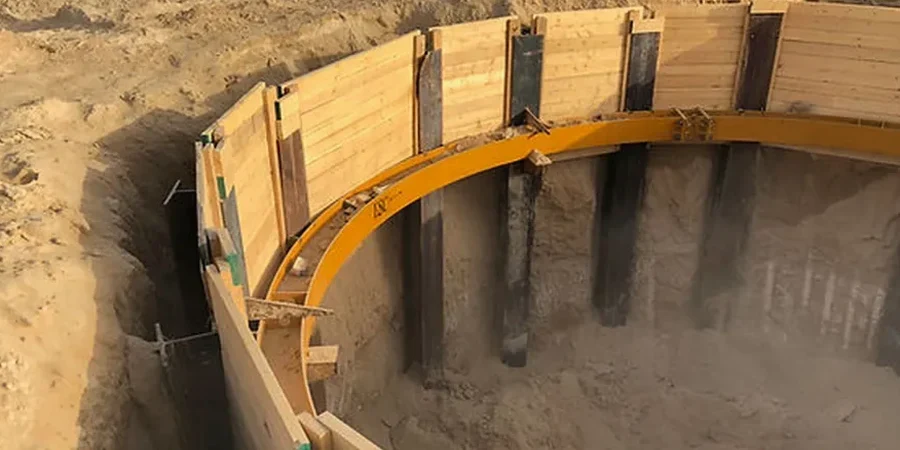
A site in Pollokshields with stiff boulder clay behaves nothing like one in the Clyde Corridor, where deep alluvial silts can extend twelve metres before hitting bedrock. That contrast defines pile foundation design across Glasgow — a city where superficial deposits shift radically within a few postcodes. Our team has worked on projects from the West End to Dalmarnock, and the brief is never the same twice. Load transfer mechanisms, pile toe levels, and shaft friction estimates have to be tuned to the actual ground profile, not a regional assumption. When boreholes reveal soft clays and groundwater within the first three metres, a driven pile solution might give way to CFA or rotary bored piles. We integrate field data from CPT testing directly into the geotechnical model, which cuts down the guesswork and keeps the pile length efficient.
Glasgow's drift geology can change completely within a single street block — pile design here is about mapping that variability, not guessing at it.
Questions and answers
How much does pile foundation design cost for a typical Glasgow project?
For most projects in Glasgow, pile foundation design fees range from £1,460 for a straightforward residential extension to around £5,080 for a multi-storey commercial building. The actual figure depends on the number of pile types, the complexity of the ground profile, and whether load testing is required.
Which pile type is most suitable for Glasgow's glacial till?
Continuous Flight Auger (CFA) piles work well in the stiff boulder clay found across much of Glasgow, because they can be installed quickly without casing in stable ground. Where the till contains large cobbles or where groundwater is high, rotary bored piles with temporary casing offer more control. We select the pile type after reviewing borehole logs and CPT data.
How do you account for old mine workings in pile design?
The Coal Authority reports and site-specific rotary drilling identify the depth and condition of workings. We design piles to bypass the worked seam entirely, socketing into competent rock below, or we specify grouting of the void prior to piling. The design follows the guidance in CIRIA SP32 and BS 8004.
What information do you need to start the pile foundation design?
We need a ground investigation report with borehole logs, in-situ test data such as CPT or SPT, and laboratory classification and strength tests. A structural loading schedule and a site plan with the proposed building footprint are also essential to begin the analysis.