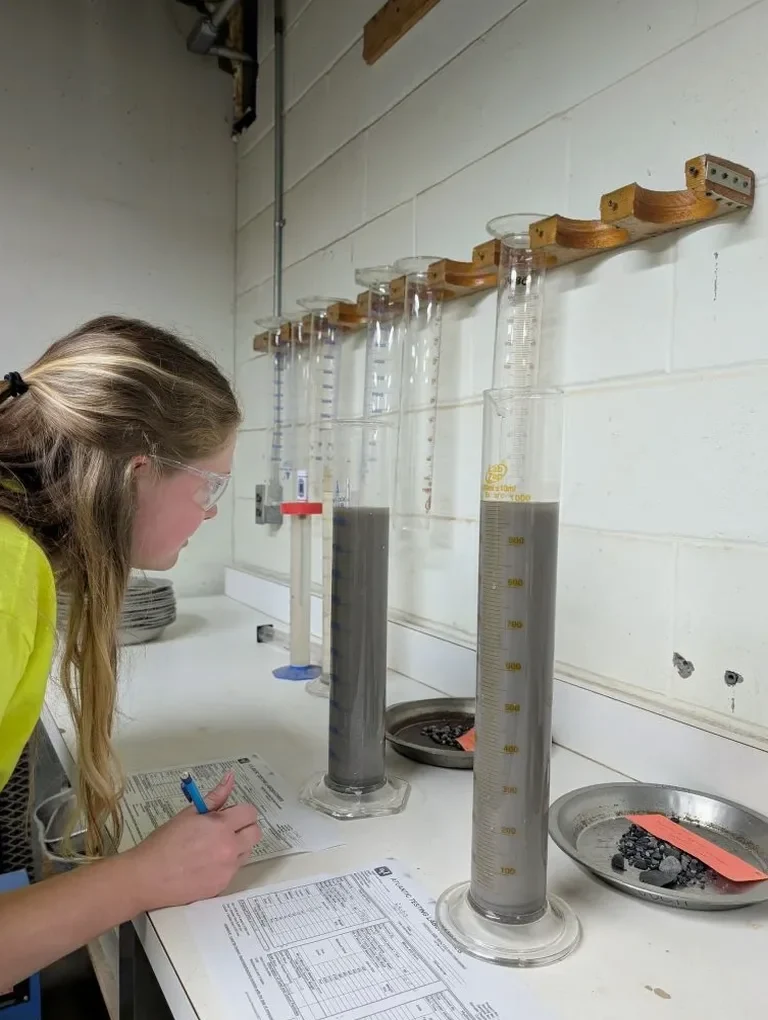
BS 5930:2015 sits on every shelf in our Glasgow lab, and honestly, when you are dealing with the glacial tills and alluvial silts that define the Clyde Valley, you need that framework front and centre. Glasgow's geology swings from dense boulder clay in the north to soft compressible clays along the river corridor, and a poorly characterised subgrade here can unravel a road pavement within two winters. Our laboratory CBR test programme runs to the letter of BS EN 1997-2, giving you soaked CBR values that reflect the worst-case moisture scenario those saturated Glasgow months will throw at the pavement. Before the asphalt goes down, we often pair the CBR with a grain size analysis to confirm the fines content, and if the material shows plasticity, the Atterberg limits help us flag volumetric instability before it shows up as rutting on Great Western Road.
A CBR value without a moisture-density relationship is just a number; in Glasgow, the soaked CBR is the only one that counts for long-term pavement performance.
Site-specific factors
Glasgow's expansion during the Victorian era left a legacy of made ground, rubble, and industrial fill that sits right where modern pavements need to be laid. The city grew fast, and the subsurface was not always documented with the rigour we apply today. We have pulled samples from beneath former shipyards in Govan where the 'soil' was more clinker and ash than anything natural, and the CBR results can swing from 2% to over 20% within half a metre vertically. The risk is not just low bearing capacity; it is differential settlement across a carriageway, and in a city with over 600,000 people relying on bus corridors and HGV delivery routes, a pavement failure is a logistical headache. A laboratory CBR test programme, properly targeted at the fill layers and the natural formation beneath them, is what separates a 20-year pavement design life from a resurfacing contract three years after opening.
Questions and answers
What does a laboratory CBR test cost in Glasgow?
For a standard soaked CBR test on a single specimen, including Proctor compaction, surcharge setup, 96-hour soaking, and penetration testing, the cost ranges from £100 to £170 per specimen. The final figure depends on the number of specimens in the batch and whether we are also doing the moisture-density relationship. A full family of five compaction points with CBR will naturally be higher, but we can give you a fixed quote once we know the spec.
Do I need the soaked or unsoaked CBR for a pavement design in Scotland?
Almost always the soaked CBR. The pavement design method in the UK assumes the subgrade will reach an equilibrium moisture content close to saturation, and Glasgow's rainfall makes that assumption a safe one. We run the 96-hour soak as standard, and the swell measurement tells you if the material is susceptible to volume change. An unsoaked test alone will overestimate the in-service bearing capacity and lead to an under-designed pavement.
How do you prepare the sample for the CBR test?
We start by sieving out any material larger than 20 mm, unless you specify otherwise, and then we compact the sample into the CBR mould using the Proctor method. The compaction effort, either 2.5 kg or 4.5 kg rammer, is chosen to match the specified density from the earthworks specification. After compaction we set up the surcharge weights, place the swell plate and dial gauge, and submerge the mould in water for 96 hours. The penetration test follows immediately after the soaking period.