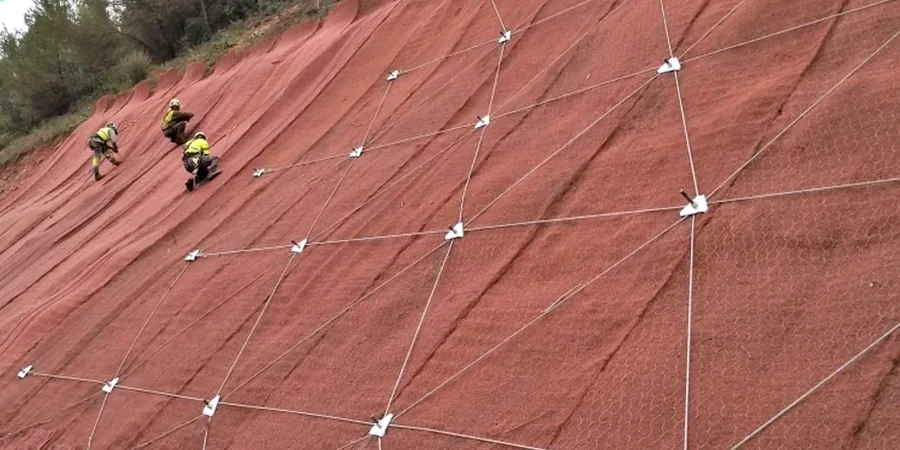
Working in and around Glasgow, you quickly learn that the city's topography is far from a simple flat river plain. The drumlin swarms south of the Clyde, the boulder clay cliffs along the Kelvin, and the legacy of shallow mine workings beneath the eastern suburbs all create a landscape where slope stability cannot be taken for granted. A standard desktop study rarely captures the complexity of a 15-metre cut in glacial till laced with silt lenses, especially when groundwater perched within the till can reduce effective stress to critical levels overnight. We pair BS 5930 ground investigation with site-specific CPT profiling to build a reliable ground model for each slope, then run limit equilibrium and, where required, finite element analyses to quantify the factor of safety under both drained and undrained conditions. For slopes in former opencast areas, we also look at how deep excavation monitoring data from nearby projects can inform a back-analysis of likely movement patterns before stabilisation measures are designed.
A slope standing at 1:2 in Glasgow till may be stable for decades and fail within hours of a water main burst – transient pore pressure is often the trigger, not weak soil.
Process and scope
Eurocode 7, implemented in the UK through BS EN 1997-1:2004+A1:2013, demands that slope stability be verified for both ultimate and serviceability limit states, but the selection of a Design Approach – DA1 Combination 1 or 2 – has a direct impact on the reinforcement length or the required berm geometry. In Glasgow, where many slopes are formed in lodgement till with a characteristic undrained shear strength of 70–150 kPa, the partial factor applied to actions and material properties often governs whether a slope passes without reinforcement. Our laboratory, accredited to ISO 17025, routinely runs consolidated-undrained triaxial tests with pore pressure measurement on Shelby tube samples taken from the critical failure surface, ensuring that the effective stress parameters c' and φ' used in the analysis are not generic textbook values but are representative of the actual till fabric at the site. When back-analysing slips in overconsolidated clays, we reference Skempton's residual strength framework to avoid the common pitfall of overestimating post-peak strength in reactivated shear zones. The output is not a single factor of safety but a range of scenarios, including sensitivity to a 1-in-200-year rainfall event and the effect of rapid drawdown where slopes border the Forth and Clyde Canal.
Site-specific factors
Glasgow's drift geology presents a specific risk profile that generic slope assessments miss. The boulder clay is not homogeneous: it contains discontinuous sand and silt partings that act as preferential flow paths for groundwater, creating localised perched water tables that can raise pore pressure at the toe of a slope without any visible sign at the surface. During the winter months, when rainfall in the west of Scotland averages over 1,200 mm annually and effective evaporation is near zero, these partings become fully saturated and the factor of safety can drop by 20–30% within a single week. A second, less visible hazard comes from the legacy of bell-pit and stoop-and-room coal mining in areas such as Shettleston and Easterhouse; crown hole collapse at shallow depth can remove passive support from the toe of a slope, triggering a progressive failure that migrates uphill. We always cross-reference historical mine abandonment plans held by the Coal Authority before finalising a slope model, and where records are ambiguous, we specify a resistivity survey to detect voids that might act as future collapse zones.
Questions and answers
How much does a slope stability analysis cost for a typical Glasgow site?
A full investigation including two to three boreholes, laboratory triaxial testing, and a limit equilibrium analysis report typically ranges from £900 to £2,950, depending on the slope height, access constraints, and whether historical mining data needs to be integrated.
What is the difference between total stress and effective stress analysis for Glasgow till?
Total stress analysis uses the undrained shear strength cu measured in the field or lab and is appropriate for short-term conditions immediately after a cut is made. Effective stress analysis uses c' and φ' and incorporates pore water pressures; it is essential for long-term stability, especially when modelling rainfall infiltration or canal drawdown. In Glasgow, we typically run both and adopt the more conservative result.
Do I need a slope stability report for a single house extension on a sloping site?
Most local authorities in the Glasgow area will ask for a slope stability assessment if the gradient exceeds roughly 1:5 and the excavation is within 6 metres of the crest of the slope. The assessment can often be a desk study plus a single borehole, but it must demonstrate that the works will not reduce the factor of safety below the value required by BS EN 1997.