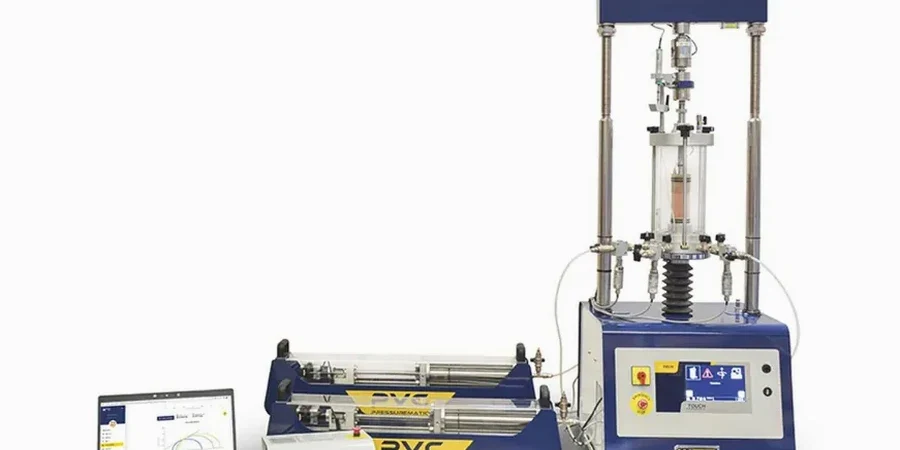
A recent ground investigation on a brownfield site near the Clyde revealed a dense layer of glacial till overlying weathered sandstone. The contractor needed reliable effective stress parameters to model the excavation support system before a single pile was driven. Standard index tests gave an indication, but the design required the full Mohr-Coulomb envelope. That is where the triaxial test becomes essential. Glasgow's geology, with its mix of stiff boulder clays, silts, and variable bedrock, demands more than just SPT numbers. A CPT test can map the stratigraphy quickly, but for critical infrastructure or deep basements, you need the strength data from a consolidated undrained triaxial test to feed directly into the geotechnical model. We run these tests in our accredited lab, handling the complex stress paths that Glasgow's overconsolidated soils produce.
A triaxial test on Glasgow's glacial till typically shows an effective friction angle between 27 and 33 degrees, but the cohesion intercept can vary significantly with the clay fraction.
Site-specific factors
The drift geology map of Glasgow shows a complex sequence of till, laminated clay, and sand and gravel lenses within the city centre. The laminated clay, often found near the Clyde corridor, can have a very low undrained shear strength and a high sensitivity. If you base a foundation design solely on borehole logs without a triaxial test, you risk underestimating the long-term settlement or the short-term stability during construction. An incorrect assessment of the effective cohesion in a fissured till can lead to a retaining wall design that is inadequate for the actual lateral earth pressures. We have seen projects where the design assumed a cohesion of 10 kPa, but the triaxial test on undisturbed samples gave a value closer to 3 kPa. That difference changes the factor of safety on a deep excavation from comfortable to critically low.
Questions and answers
What is the typical cost of a triaxial test suite in Glasgow?
For a set of three specimens to define the Mohr-Coulomb envelope, the cost typically ranges from £1,440 to £2,300. The final figure depends on the soil type, specimen size, and whether you need a single-stage or multi-stage test. We provide a fixed-price quote after reviewing the sample condition and your project specification.
How long does it take to get the results from a consolidated undrained triaxial test?
The full test programme, including saturation, consolidation, and shearing of three specimens, typically takes seven to ten working days. Silt and clay samples from Glasgow sites often have low permeability, so the consolidation and saturation phases alone can take several days. We can provide preliminary results earlier if the shearing stage is complete.
What size of sample do you need for a triaxial test?
We can run tests on specimens from 38 mm up to 100 mm in diameter. For Glasgow's glacial till, which can contain fine gravel and cobbles, a larger 100 mm diameter specimen gives the most representative strength data. The sample must be undisturbed, preferably from a U100 or Shelby tube, to preserve the in-situ structure and water content.